
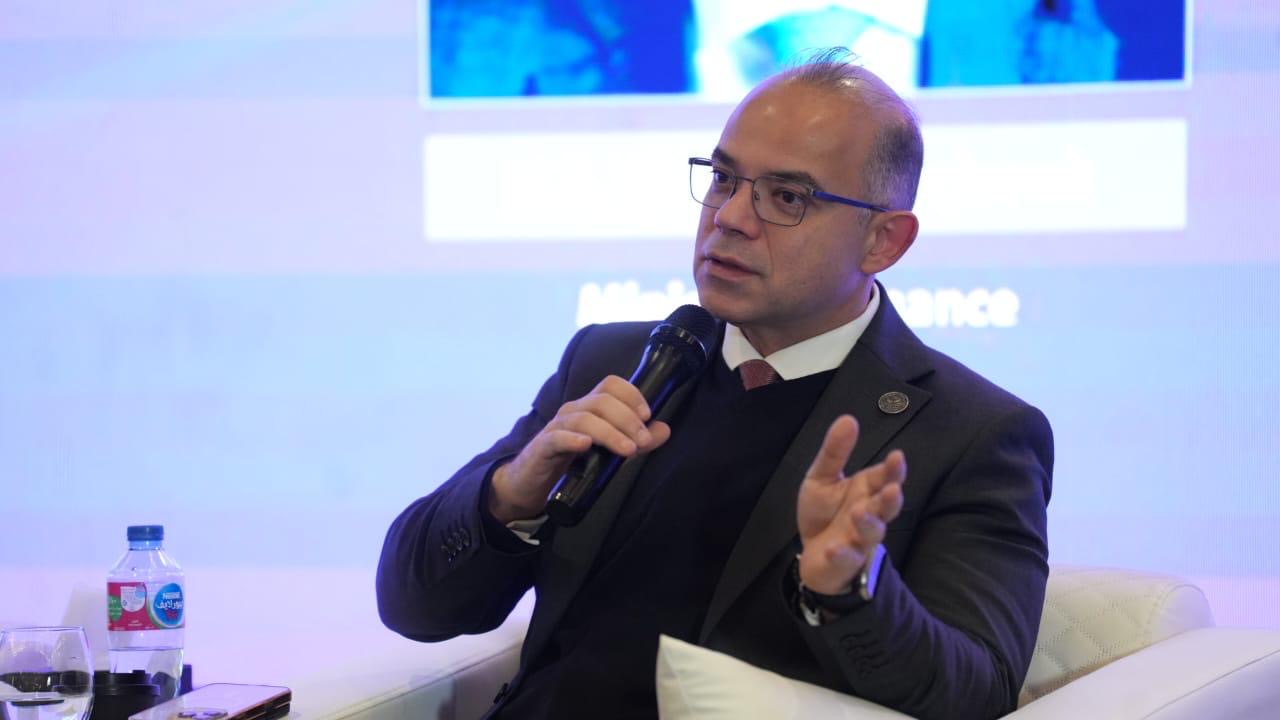
Dr. Mohamed Farid – FRA Chairman:
- Listing rules should be viewed as a benchmark for corporate quality rather than a set of regulatory rules.
- Recent amendments to listing rules are designed to stimulate market expansion and fortify investor trust in the Market.
- A primary objective of the new amendments is to empower emerging, companies to access the Exchange.
- SPAC experience is a practical model of flexibility within listing rules.
- Listing on the stock exchange enhances merger and acquisition opportunities and boosts the promotional capabilities of companies.
- Investing in human capital is a fundamental requirement for the sustainability of listed companies.
- Developing secondary market bond trading supports pricing discipline and the creation of a yield curve.
- Reform success is not achieved by rules alone, but by the flexibility and readiness of market participants.
- The reform process necessitates time, institutional harmony, and the unwavering belief of every market actor.
- eKYC has catalyzed the rise of fractional real estate ownership, triggering 21 new applications for investment fund.
Dr. Mohamed Farid, FRA Chairman delivered the keynote speech at the 9th Al-Borsa Newspaper Capital Markets Summit, titled “FinTech… The Path to Investment Inclusion.” The event was attended by Mr. Ahmed Kouchouk, Minister of Finance, Dr. Islam Azzam , EGX Chairman and numerous officials from investment entities and corporations.
During the opening session moderated by Fatma Salah, Managing Editor of Al-Borsa, Dr. Farid reviewed FRA’s strategy in developing the regulatory frameworks governing the capital market. He emphasized that listing rules should not be viewed as mere regulatory constraints or procedural requirements, but rather as a pivotal tool to ensure the quality of listed companies and build a more efficient, credible, and sustainable market capable of growth.
FRA Chairman explained that any development or amendment to the listing rules is not intended to impose additional restrictions on companies. Instead, it is part of a broader vision aimed at enabling the market to achieve growth, improving the quality of operating entities, and enhancing its ability to attract both local and foreign investment.
He emphasized that a direct correlation exists between the credibility of regulatory reforms and overall market trust. As stakeholders gain conviction in the efficacy and strategic value of these updates, there is a measurable positive impact on both investment appetite and trading volumes.
FRA Chairman noted that previous amendments to listing rules specifically targeted empowering growth-stage companies to leverage the benefits of listing. He cited the Egyptian SPAC (Special Purpose Acquisition Company) experience as a successful practical model, which allowed promising companies to enter the market and benefit from funding and institutional visibility without being bound by traditional paths.
He added that entering the market makes companies more attractive for Mergers and Acquisitions due to their transparency and structural/disclosure discipline. Furthermore, he highlighted the significant gap in promotional capabilities between listed and unlisted companies.
Dr. Farid emphasized that listing does not only impact a company’s ability to secure funding but also triggers a fundamental shift in management style, governance, and institutional discipline. He stressed that any company that fails to spend on human capital or invest in training its staff will not achieve sustainability, noting that the success stories of many listed firms are closely linked to capacity building and skill development.
Regarding market infrastructure, FRA Chairman explained that developing trading system for the secondary bond market is a major step toward market efficiency. This contributes to greater discipline in pricing financial instruments and creates a real yield curve that accurately reflects supply and demand, thereby supporting investment decision-making and price transparency.
Dr. Farid underscored that the success of any market development or reform is not achieved solely by issuing new rules. It requires flexibility and readiness from companies and market institutions to match the readiness of the regulator.
He asserted that reform is a participatory process requiring the conviction of all parties and the effective execution of their respective roles. He pointed out that many tools currently used in the market were not created overnight but are the result of years of work—such as financial derivatives (since 2007) and short-selling mechanisms (since 2003) – reflecting that true reform requires time and complete harmony between various stakeholders.
Concerning the role of technology in supporting investment inclusion, Dr. Farid indicated that the implementation of the electronic “Know Your Customer” (eKYC) mechanism was the foundation for the growth of fractional real estate investment. This simplified market entry for a broader segment of investors, resulting in over 21 applications to establish investment funds in this field, compared to only two funds in the history of the Egyptian market prior to these changes.
Dr. Mohamed Farid concluded his speech by reiterating that developing listing rules is a cornerstone for building stronger companies and a deeper, more trusted market capable of supporting economic growth and sustainability. He stressed that when regulatory rules are formulated with a developmental vision, they become a true driver of progress rather than just a regulatory framework.
Tags: Dr. Mohamed Farid, Fintech, FRA (Financial Regulatory Authority), Capital Markets, Listing on the Stock Exchange Last modified: February 8, 2026