
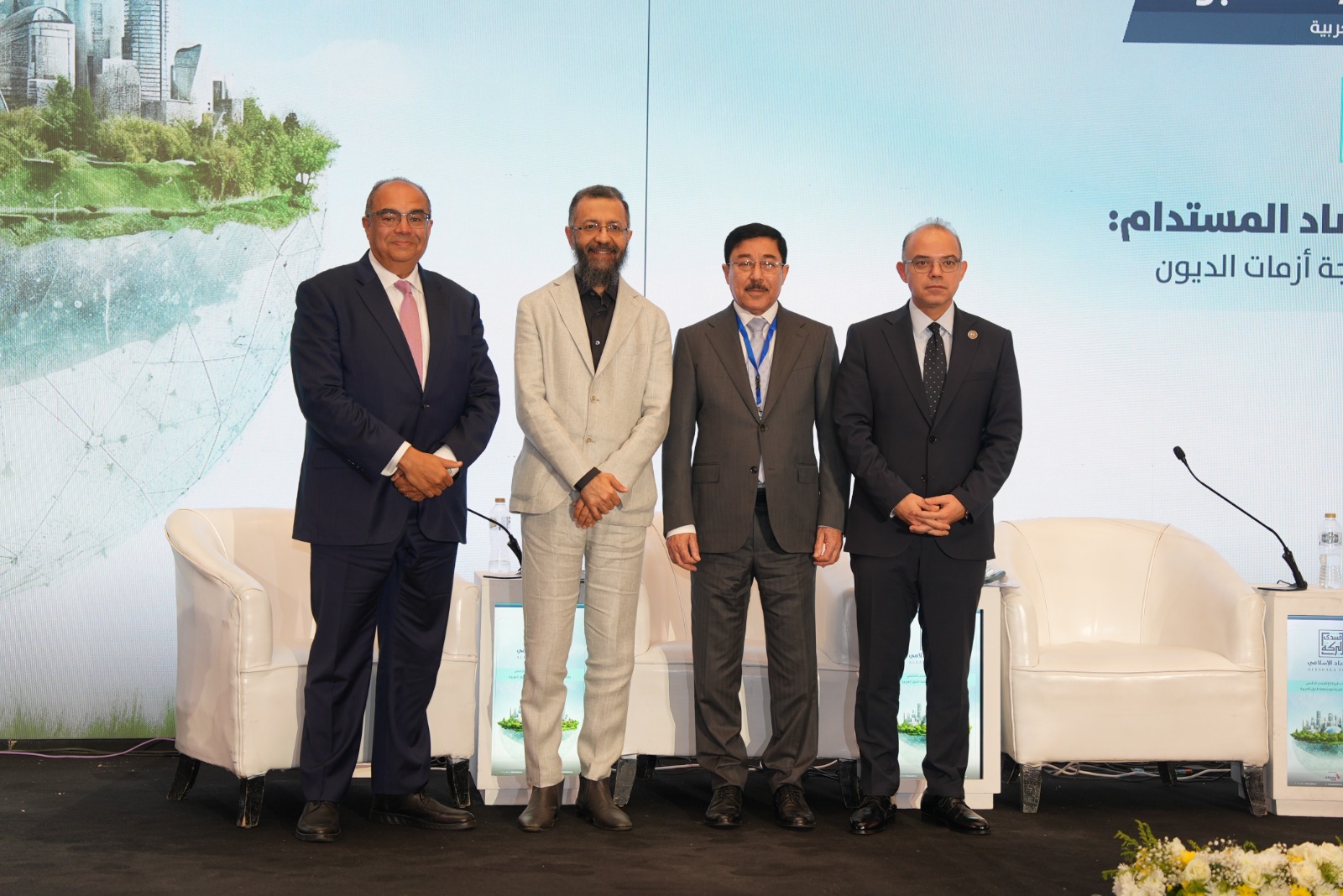
- In-depth talks addressed development finance and the global debt crisis, emphasizing ethical and sustainable financing.
Dr. Mohamed Farid:
- Low savings rates are a primary driver of escalating debt.
- Nations are responsible for financing their own development through diverse mechanisms; their future lies solely in their own hands.
- The Egyptian market is witnessing a surge in sustainability bond issuances.
- Market stability is a fundamental prerequisite for maximizing financing impact.
- Real Estate Investment Trusts (REITs) are witnessing unprecedented expansion.
Dr. Mohamed Farid, FRA Chairman participated in the opening session of the 5th edition of Al Baraka Regional Forum in Cairo, held in strategic partnership with the Arab League. The session was moderated by Dr. Mahmoud Mohieldin, UN Special Envoy on Financing the 2030 Sustainable Development Agenda and featured Dr. Ali Mohsen Al-Alaq, Governor of the Central Bank of Iraq.
Dr. Farid emphasized that nations must precisely define the responsibility for development finance. He explained that current challenges are symptoms of low national savings rates, which drive an increased reliance on borrowing – a cycle that has escalated into the current global debt crisis.
He highlighted the critical need to establish channels that facilitate savings and subsequent investment. This approach provides essential funding for diverse initiatives, spanning both “bankable” and “unbankable” projects.
FRA Chairman stressed that nations must realize that their growth and future prosperity lie solely in their own hands. Consequently, countries must take full responsibility for financing their development through diversified and innovative mechanisms.
Dr. Farid noted the shifting landscape of debt ownership. Unlike the previous three decades – when the Paris Club held the majority of sovereign debt – today’s debt is fragmented and distributed among a much wider array of creditors and stakeholders.
He pointed out that FRA has implemented a comprehensive legislative and regulatory reform. Driven by a belief in Sharia-compliant instruments, these reforms have successfully activated sustainable and Islamic finance tools, including the regulation of Sukuk issuances and Takaful insurance.
The Chairman highlighted the evolution of Sharia supervisory sub-committees within FRA-regulated institutions. He noted the maturing dynamics and workflows between these sub-committees and FRA’s Central Sharia Oversight Committee.
Dr. Farid underscored that achieving desired outcomes and meeting Sustainable Development Goals (SDGs) fundamentally depends on the will and diligent effort.
He emphasized that balancing oversight with empowerment is critical. He noted that any financial regulator’s primary objectives are to ensure market stability and protect all participants – whether they are capital market investors, insurance policyholders or consumers of non-banking financial services (NBFS).
He continued by stating that market stability, coupled with advanced regulatory frameworks, is a prerequisite for driving development, expanding market size and leveraging diverse financing tools. He pointed out his efforts to develop the sustainability bond activity in Egypt, which lacked clear regulation prior to his leadership at the Authority.
In response to a query from Dr. Mahmoud Mohieldin regarding the latest developments in the NBFS sector, FRA Chairman highlighted the decisive role of new legislative and regulatory frameworks in activating a wide array of financing instruments.
He noted the significant progress in sustainability bonds, highlighting Egypt’s first sustainability bond issuance in 2024, valued at $100 million. This was followed by the issuance of sustainability-linked securitization bonds worth $499 million in February 2024.
He added that further securitization bonds worth EGP 11.5 billion were issued, alongside the Egyptian market’s inaugural sustainability Sukuk issuance, valued at EGP 11 billion in May 2024.
Dr. Farid asserted that the lack of clear definitions had been a major hurdle for years. The development of robust regulatory rules has enabled projects that were previously excluded from traditional financing to access capital, thereby supporting the real economy and creating jobs.
He revealed that the number of real estate funds in Egypt had stagnated at just two from 2020 until 2025. However, recent regulatory amendments sparked a surge, with approximately 12 funds applying for licenses within just three months, supported by eight digital crowdfunding platforms dedicated to these funds.
He also pointed to the growth of Islamic Sukuk issuances following executive amendments to the Capital Market Law that standardized Sukuk definitions. These changes led to a significant increase in total issuances, reaching EGP 33.5 billion.
Furthermore, he noted that FinTech and crowdfunding have expanded the investor base, empowering new segments of society to participate in investment opportunities, particularly within the real estate and development sectors.
FRA has also enabled electronic “Know Your Customer” (E-KYC) procedures. To date, approximately 400,000 digital verification transactions have been completed.
Dr. Farid stressed the necessity of offering Islamic financing tools through digital platforms to align with the preferences and behaviors of younger generations, specifically Generation Z and Generation Alpha.
He concluded by emphasizing that the role of financial regulation extends beyond merely encouraging innovation; its core purpose is to achieve financial stability and protect investor rights. This foundation ensures sustainable market growth, bolsters confidence in new financing tools and transforms them into a genuine engine for development finance.
Tags: FRA Chairman, Financial Regulatory Authority (FRA), AlBaraka Regional Forum, Dr. Mahmoud Mohieldin, Governor of the Central Bank of Iraq Last modified: December 18, 2025