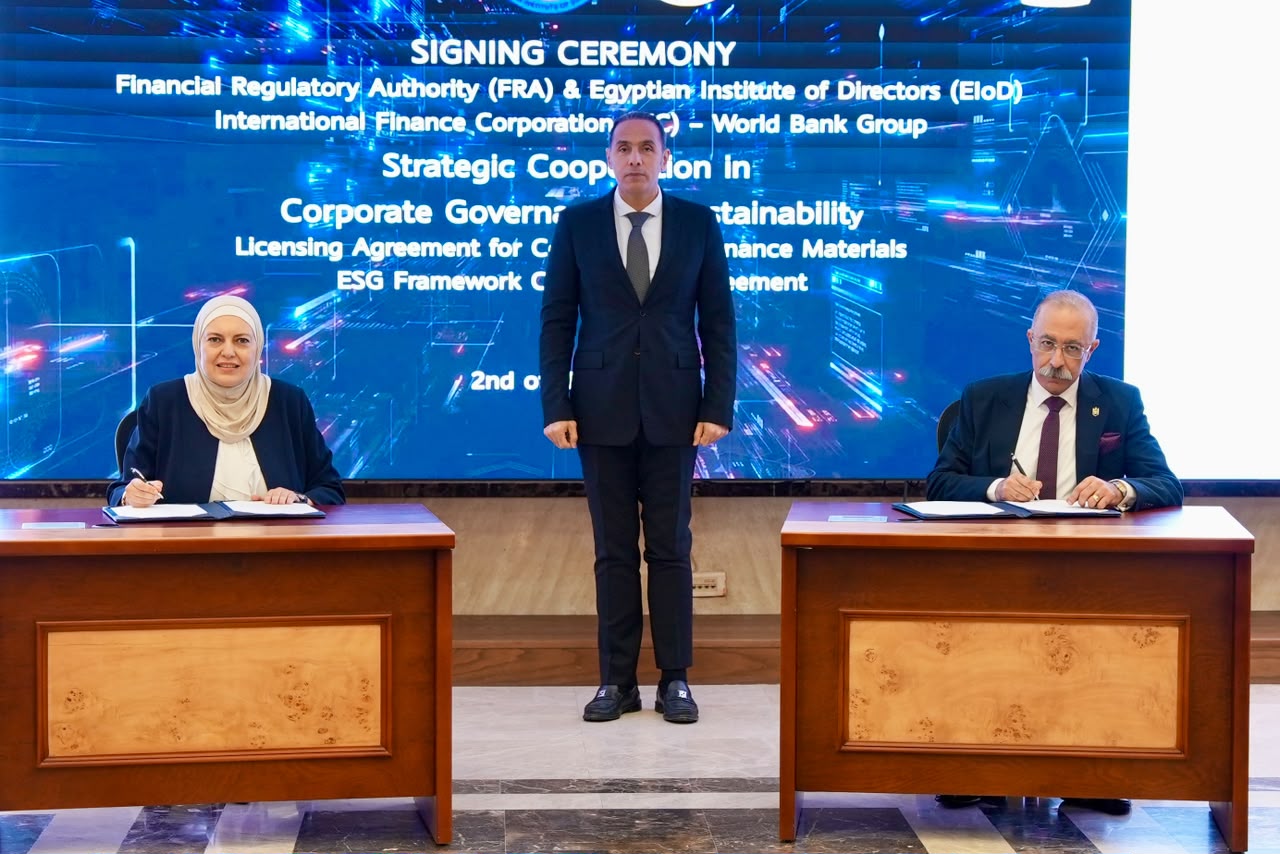
- An Agreement to Develop an ESG Assessment Framework in the Non-Banking Financial Sector… and Another to Support the Egyptian Institute of Directors with Specialized Educational Materials
Dr. Islam Azzam, FRA Chairman witnessed the signing ceremony of two agreements between the Authority and the International Finance Corporation (IFC), a member of the World Bank Group. The agreements cover environmental, social and corporate governance (ESG), sustainability and corporate governance.
This comes as part of the Authority’s continuous efforts to develop regulatory frameworks and institutional practices, as well as to promote the application of governance and sustainability principles across non-banking financial institutions.
Dr. Tarek Seif, FRA Vice Chairman, on behalf of FRA, and Dr. Amira El-Saeed Agag, IFC Governance Projects Manager in Egypt signed the agreements.
The first agreement stipulates that the IFC will provide advisory and technical services to FRA to strengthen sustainability and ESG framework. This includes designing an ESG Scorecard to evaluate corporate sustainability performance, establishing core indicators and technical standards, and reviewing the Authority’s new sustainability reporting framework to provide technical feedback.
The partnership also includes drafting a preliminary framework outlining the proposed roles and responsibilities for Sustainability Officers within institutions, aligned with international best practices. Additionally, the IFC will organize specialized workshops to train FRA staff on International Sustainability Disclosure Standards (IFRS S1) and Climate-related Disclosures (IFRS S2), strengthening their technical capacity to oversee disclosure requirements and evaluate corporate sustainability practices.
The second agreement, signed between the Egyptian Institute of Directors (EIoD)— FRA’s training arm—and the IFC, grants the Institute a three-year license to utilize and adapt specialized IFC corporate governance materials across its certified training programs.
These educational resources cover four specialized programs and manuals: Sustainability Training for Board Members, Board Member Certification Program, Board Secretaries Manual and Internal Control Environment Manual. The materials focus on developing corporate governance practices, identifying actions required to improve governance frameworks, clarifying the roles and responsibilities of board secretaries and enhancing knowledge of internal control systems, risk management, internal audit and compliance.
Dr. Islam Azzam, FRA Chairman emphasized that ongoing cooperation with international organizations in sustainability and governance reflects the Authority’s commitment to develop the sectors under its supervision. He noted that this approach pairs regulatory enhancement with the technical tools needed for implementation, while simultaneously building the capacity of professionals responsible for execution within institutions.
He added that sustainability agreement with the IFC outlines specific technical deliverables, including the development of a corporate ESG scorecard, a review of sustainability reporting framework, and support in defining standard roles for sustainability officers. These measures aim to strengthen performance monitoring across institutions while elevating the quality and transparency of ESG disclosures.
Dr. Islam Azzam also noted that providing specialized educational materials to the Egyptian Institute of Directors will support the development of its professional programs and broaden the scope of training topics. These will encompass qualifying board members, sustainability governance, roles of board secretaries, internal control systems, risk management and compliance.
For his part, Dr. Tarek Seif, FRA Vice Chairman highlighted that establishing standard roles and responsibilities for Sustainability Officers is a cornerstone of this collaboration. He noted that this function is critical for managing institutional sustainability portfolios, streamlining data collection and reporting and embedding sustainability into operational workflows and executive decision-making. Furthermore, training FRA personnel on IFRS S1 and IFRS S2 standards equips regulatory staff to effectively oversee climate and sustainability disclosures.
Regarding the collaboration with the Egyptian Institute of Directors (EIoD), FRA Vice Chairman noted that training outcomes undergo continuous evaluation using key performance indicators (KPIs). These metrics track enrollment figures, participant satisfaction rates, and institutional implementation of program recommendations—allowing the Authority to evaluate training impact and refine course content continuously.
Last modified: November 5, 2026