
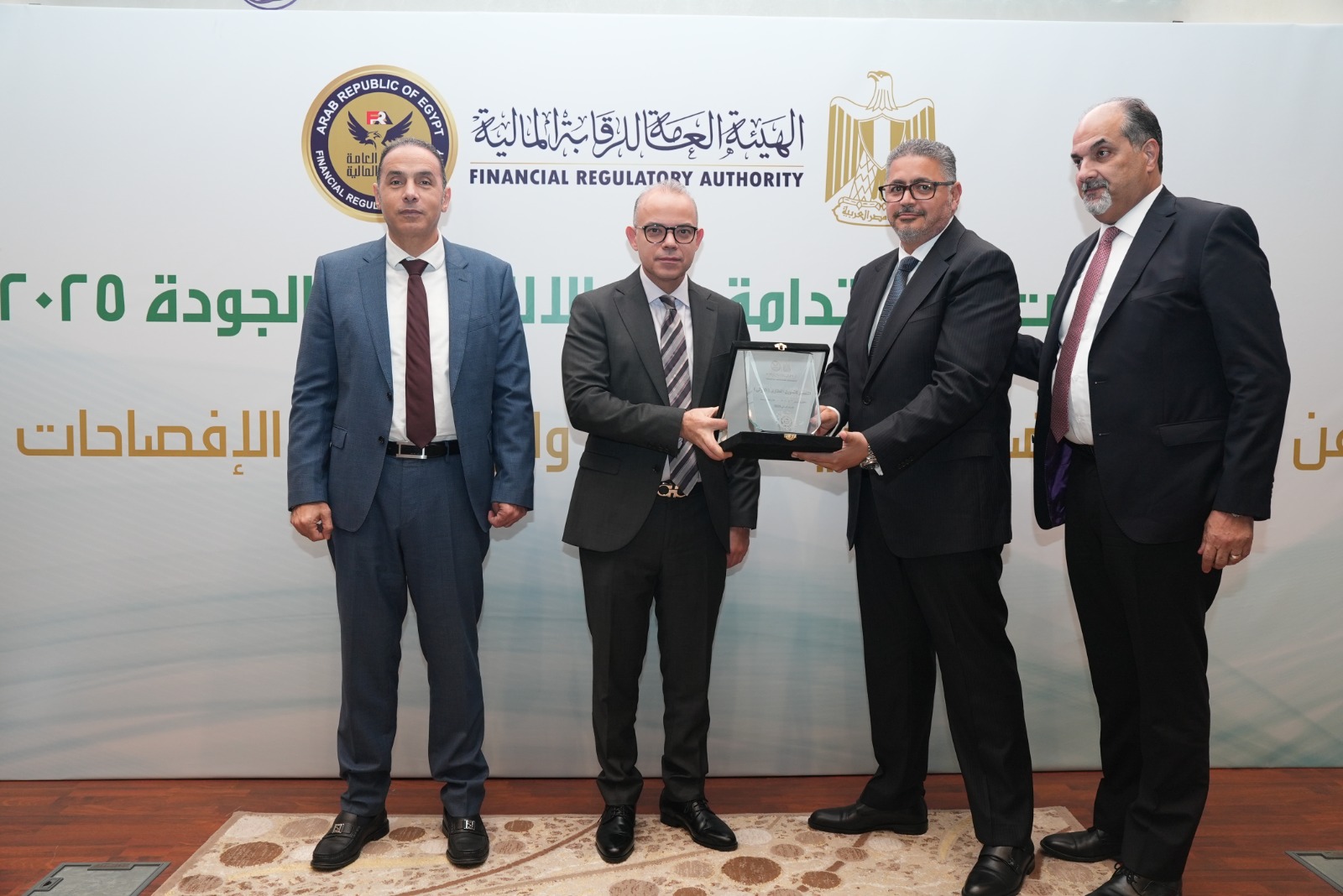
On the sidelines of a workshop titled: “Sustainability Disclosures: From Compliance to Quality 2025”
Dr. Mohamed Farid:
- FRA is leading a new regulatory phase that moves beyond basic compliance to focus on evaluating quality of disclosures and measuring their real impact.
- Companies must prioritize capacity building by developing robust internal systems for high-precision data collection and advanced analytics.
Within the framework of Financial Regulatory Authority’s (FRA) strategy to keep pace with rapid developments in financial markets, and amidst growing local and international focus on sustainability and climate issues, the Authority organized a workshop titled “Sustainability Disclosures: From Compliance to Quality – 2025.” The event was held alongside a ceremony honoring top-performing companies in sustainability and climate reporting, attended by Dr. Mohamed Farid, FRA Chairman, Dr. Islam Azzam, EGX Chairman, and several corporate leaders and representatives.
A new precedent in a first-of-its-kind initiative, the ceremony recognized 13 companies that led the technical analysis rankings based on FRA’s methodology for 2024 sustainability and climate disclosure reports. This move underscores the Authority’s commitment to enhance transparency and elevate the quality of Environmental, Social, and Governance (ESG) disclosures, as well as those related to the Task Force on Climate-related Financial Disclosures (TCFD) within the non-banking financial sector.
Dr. Mohamed Farid, FRA Chairman emphasized the vital importance of integrating sustainability considerations and climate risks into corporate disclosure frameworks. He noted that such integration plays a pivotal role in boosting financial market efficiency, solidifying investor confidence, and strengthening the resilience of institutions against future challenges
List of honored companies included: EFG Holding, Qalaa Holdings, Alexandria Medical Services, Delta Sugar, TAQA Arabia, Camel Ventures, Taamir Mortgage Finance (Al Oula), GB Corp, Middle East Glass Manufacturing, Arabian Cement Company, Mashroey Trading Company (Mashroey), Orascom Investment Holding, and Commercial International Bank (CIB).
Dr. Farid added that the Authority is launching a new era focused on evaluating the quality, depth, and effectiveness of disclosures. The goal is to determine how well these reports reflect material risks and opportunities and influence the decisions of both management and investors. Furthermore, FRA aims to establish sustainability and climate issues as core elements of sound corporate governance and long-term risk management.
FRA Chairman explained that the Authority’s approach to evaluate disclosures is a pioneering model for the market. It builds upon FRA’s leadership in setting disclosure requirements, as the Authority now spearheads a more advanced phase centered on assessing disclosure quality and measuring its actual, real impact.
Moreover, Dr. Farid pointed out that while quantitative compliance rates were relatively positive, the technical analysis revealed a clear gap between superficial compliance and the required depth and quality of content. He stressed the need to bolster institutional capabilities within companies, modernize internal data collection and analysis systems, and create a stronger link between disclosures and actual decision-making.
For his part, Dr. Islam Azzam, EGX Chairman stated that the capital market plays a crucial role in supporting high-quality disclosures. He emphasized that listed companies must provide comprehensive information that reflects sustainability-related risks and opportunities, thereby enhancing market efficiency and supporting sustainable development.
The event featured a detailed presentation of the annual report on sustainability and climate disclosure evaluations. It included an analysis of corporate compliance levels and disclosure quality, as well as an overview of the technical methodology and evaluation mechanisms used, presented by Ms. Aya Ali, Manager of Sustainable Development Department – FRA.
The workshop aimed to raise institutional awareness regarding the importance of high-quality disclosure. It positioned reporting not merely as a regulatory obligation, but as a critical tool for risk management, improved decision-making, and enhanced competitiveness- especially given the escalating global focus on climate change and its direct impact on financial stability and business continuity.
Last modified: January 4, 2026