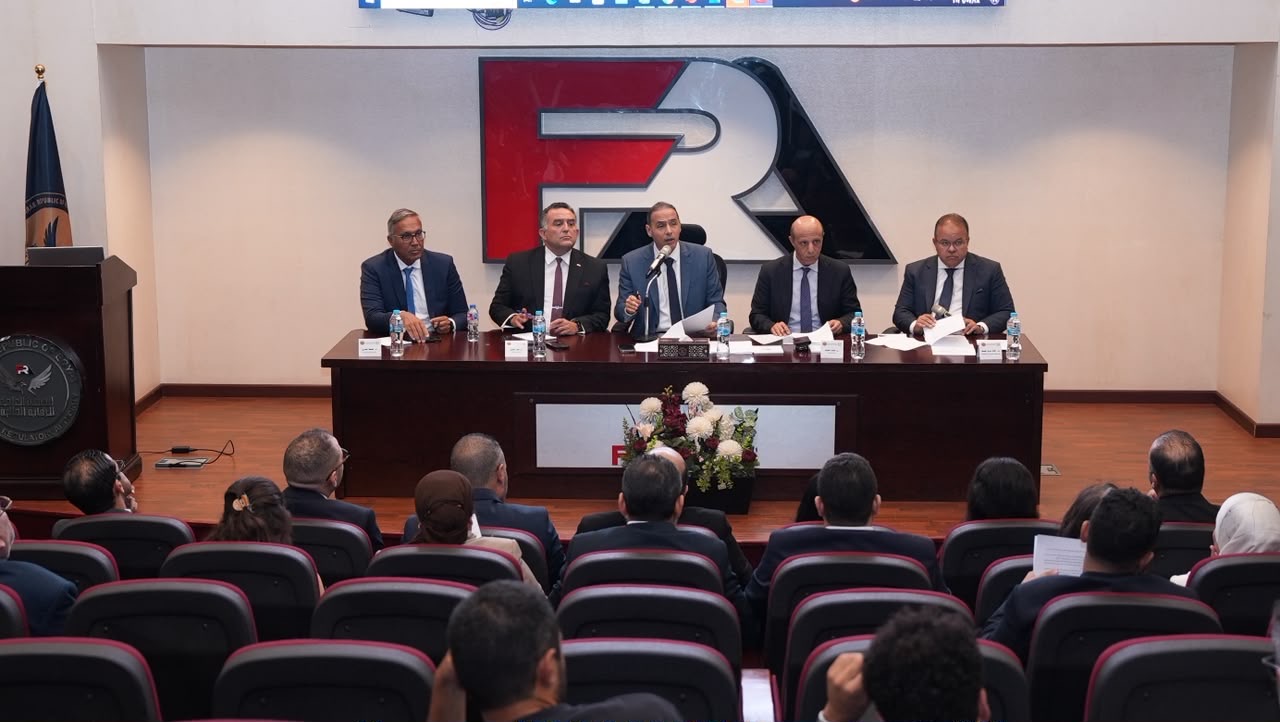
The meeting convened leaders from the Egyptian Exchange (EGX), MCDR, brokerage firms and investors to review the final steps toward launching short selling mechanism.
Dr. Islam Azzam – FRA Chairman:
- Short selling will boost the Egyptian Stock Exchange’s appeal and drive market liquidity.
- The new regulatory frame explicitly defines all parties’ roles with full system integration.
- Designed to draw in foreign funds and younger retail investors.
- Success hinges on widespread investor awareness and market education.
- FRA reaffirms its commitment to align with market stakeholders before issuing non-banking financial rules.
Financial Regulatory Authority (FRA), chaired by Dr. Islam Azzam, convened an expanded meeting at its headquarters to discuss the new regulatory framework for Short Selling on the Egyptian Exchange scheduled for release in the coming days.
The meeting was attended by Mr. Omar Radwan, EGX Chairman ; Dr. Khaled Serry Seyam, Chairman of Misr for Central Clearing, Depository and Registry (MCDR); Mr. Mohamed Al-Sayyad, FRA Vice Chairman. In addition to Mr. Mohamed Sabry, EGX Vice Chairman; Eng. Hisham Mabrouk, Managing Director of MCDR; along with senior leaders and technical teams from FRA, EGX, capital market stakeholders and brokerage firm representatives.

Dr. Islam Azzam emphasized that discussions surrounding the new short-selling framework reflect the Authority’s commitment to maintain continuous dialogue with market participants. He noted that listening to diverse perspectives and proposals helps refine regulatory frameworks by consensus, enhancing overall market readiness for upcoming developments and boosting the Egyptian market’s appeal to both domestic and foreign investors.
Short selling is a trading mechanism that enables investors to trade securities when anticipating a decline in a stock’s price. Under this mechanism, an investor borrows shares from their owner, sells them at the current market price and repurchases them later at a lower price to return them to the original owner.
The mechanism operates through a Lender (the original owner of the securities) and a Borrower (the investor borrowing the securities to sell and rebuy based on downward price expectations), allowing the borrower to profit from the price differential between the sale and repurchase based on the investor’s expectations of market movements and stock price fluctuations.
When anticipating a price decline in a specific security, an investor may borrow shares from an eligible lender and execute a market sale, backed by a required cash margin.
Upon price drop, the borrower repurchases the shares, realizes a net profit after deducting borrowing costs and returns the securities to the original owner.
Conversely, if shares’ price rises and the borrower wishes to limit their losses, they repurchase the shares at a loss and return them to the lender, incurring additional borrowing costs.
In both scenarios, the lender earns a return on lending their shares while retaining all other ownership rights and benefits associated with the security.
During the meeting, participants reviewed the latest developments in finalizing the regulatory and operational infrastructure for the short-selling mechanism. The objective is to ensure a fully integrated rollout that aligns with international best practices regarding transparency and governance, while guaranteeing continuous connectivity among all market participants to expand and deepen the market.
Attendees also reviewed key components of the new regulatory framework governing short selling. The framework aims to streamline procedures for all investor segments and drive adoption upon its official launch on the Egyptian Exchange.
For his part, Dr. Islam Azzam emphasized that the success of short selling requires intensifying market awareness and promoting investment literacy among prospective borrowers and lenders alike, ultimately driving market efficiency and boosting liquidity.

FRA Chairman further commended the pivotal role played by Misr for Central Clearing, Depository and Registry (MCDR) in establishing the Central Lending System. The system documents all operational stages and procedures—specifically displaying available lendable securities by name, quantity, lending duration, and acceptable rate, while maintaining comprehensive records of borrowing transactions, lenders, borrowers, and transaction closures—serving as the core technical foundation for the new system’s success.
He added that the new regulatory framework will boost participation in short selling among foreign and younger investors. It expands available investment avenues, enables more efficient portfolio management, creates greater opportunities to generate returns, capitalizes on price movements, and allows reinvestment of profits into new opportunities.
FRA Chairman explained that the updated rules ensure rapid responsiveness to market shifts, driving efficient risk management and investor protection. This is achieved through full integration between brokerage firms and MCDR, explicitly defining the duties and responsibilities of each party at every stage of short-selling transactions—from stock lending availability to final settlement.
Regarding the insights and proposals shared by brokerage representatives and investors during the session, Dr. Islam Azzam stated that FRA takes all market perspectives into account when drafting or amending non-banking financial sector regulations to proactively resolve potential operational challenges.
Concluding the meeting, FRA Chairman noted that coordination remains ongoing with the EGX, MCDR, and market participants to launch short selling after years of anticipation and technical and legal deliberations. Highlighted as one of the most successful instruments in regional and global capital markets, Dr. Islam Azzam urged brokerage firms to swiftly build technical and operational readiness to seamlessly integrate into the new system as soon as possible.
Tags: Egyptian Exchange (EGX), Misr for Central Clearing, Depository and Registry (MCDR), Short Selling Last modified: July 30, 2026