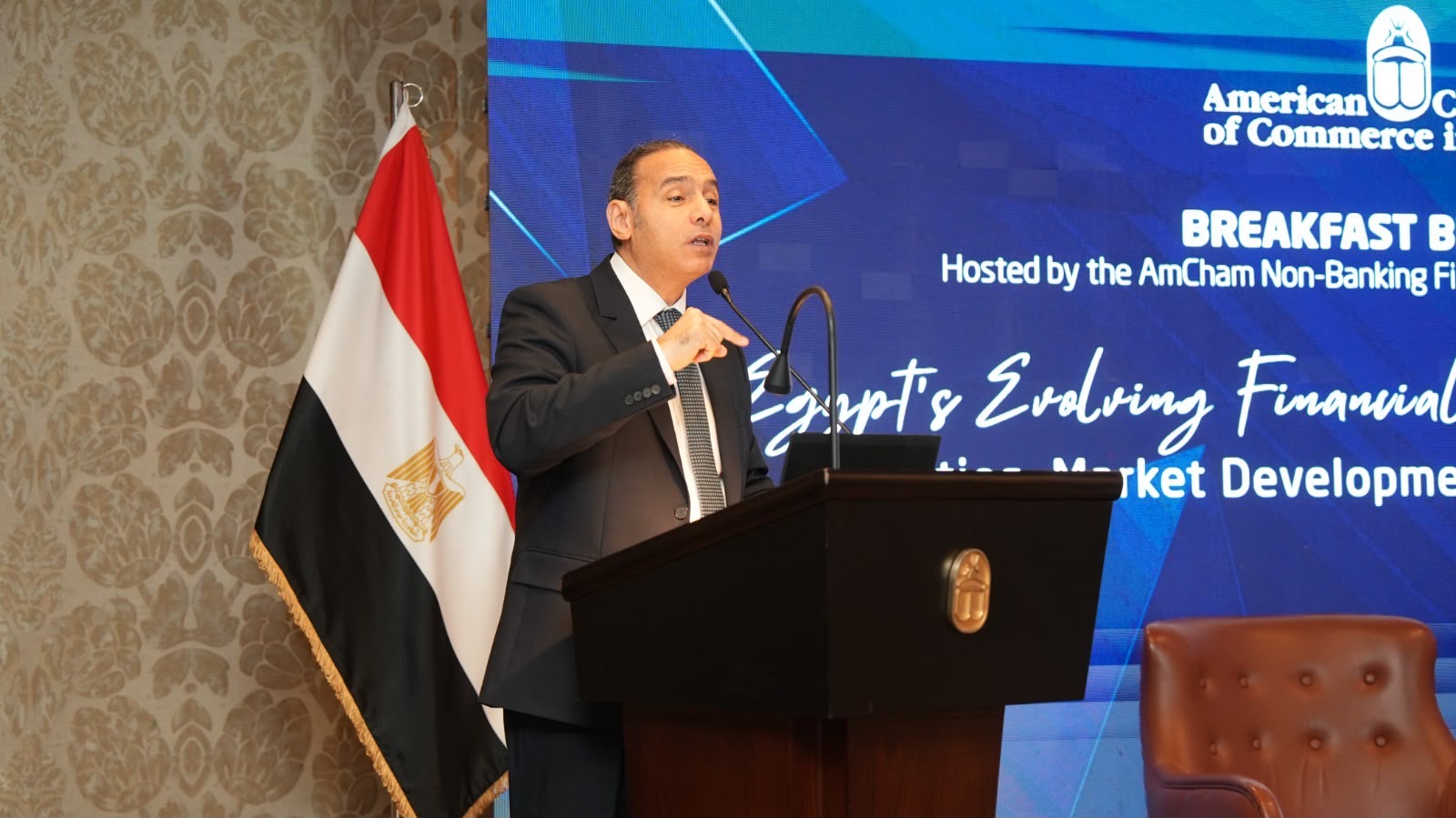
FRA Chairman:
- “Short selling will attract new EGX investors, while Market Makers remain vital for upcoming government IPOs.”
- “Continuous support for IPOs through robust capacity building, governance and disclosure awareness.”
- “Financial technology is the top priority; FRA-Sandbox is fully open for new innovations.”
- “Digitally linking all non-banking sectors to streamline indicators and sharpen decision-making.”
- “Regulatory frameworks unlock major opportunities to launch new financial products.”
- “Warning lists and enforcement measures actively shield citizens from unlicensed entities.”
- “Leveraging the Unified Insurance Law to strengthen governance, boost solvency and maximize sector attractiveness.”
Dr. Islam Azzam, FRA Chairman met with members of the American Chamber of Commerce in Egypt (AmCham) during an event organized by the Chamber’s Non-Banking Financial Institutions Committee. Titled “The Evolution of Egypt’s Financial Regulatory Landscape: Market Development and Future Outlook,” the event gathered a distinguished group of industry leaders, institutional executives and both local and international investors spanning the capital markets, insurance and financing sectors.
During his keynote address, FRA Chairman highlighted the prominent developments achieved across non-banking financial activities. He mapped out the Authority’s strategic vision for future growth across legislation, regulation, oversight, market practices and innovation. Dr. Azzam emphasized that this vision aligns with successful international benchmarks and rapid technological shifts, ultimately elevating the Egyptian market’s global competitiveness and driving national financial inclusion – a core pillar of Egypt Vision 2030 for sustainable economic growth.
Dr. Islam Azzam’s keynote seamlessly balanced a precise technical breakdown of market developments with direct interaction, addressing a wide range of regulatory inquiries raised by investors. Furthermore, FRA Chairman engaged deeply with practical proposals aimed at overcoming operational bottlenecks and emerging market challenges, pledging to evaluate viable, legally compliant solutions within the relevant statutory frameworks.
Regarding the capital market, FRA Chairman highlighted that the launch of futures trading on the Egyptian Exchange (EGX) marks a pivotal milestone in developing the financial derivatives market. He noted that these instruments provide investors with highly efficient tools for risk management and portfolio diversification. Furthermore, introducing this infrastructure against the backdrop of recent geopolitical tensions in the region underscores Egypt’s structural stability and resilient economic opportunities. Dr. Islam Azzam added that FRA looks forward to welcoming more brokerage firms into this space to boost competition and deepen market liquidity.
Furthermore, he highlighted that the FRA is finalizing the operational framework for short selling, collaborating closely with the Egyptian Exchange and MCDR. This mechanism is being built in strict compliance with international standards for disclosure and risk mitigation. Once launched, it will drive market liquidity, boost trading efficiency and maximize the stock market’s appeal to domestic and international investors.
FRA Chairman indicated that the Market Maker mechanism remains a top priority for FRA in the coming period, serving as a critical tool to enhance trading stability and boost liquidity. He explained that market participants utilizing this mechanism will benefit from stamp duty exemptions. Furthermore, FRA is evaluating additional incentives to stimulate institutional investment, aligning perfectly with the upcoming listing and public offerings of major state-owned enterprises on the EGX.
Dr. Islam Azzam briefs investors on FRA’s pivotal role in the government IPO program which aims to broaden ownership structures and maximize asset management efficiency. The Authority is actively working to eliminate operational bottlenecks and provide a supportive regulatory environment during temporary listing windows. Additionally, FRA is focused on upgrading the professional capabilities of corporate personnel to ensure full alignment with governance, disclosure and transparency frameworks.
FRA Chairman highlighted the development of Real Estate Investment Funds and the digital platforms created for trading their certificates. This modern financial vehicle allows individuals to invest indirectly in income-generating real estate assets, enabling portfolio diversification without the need for direct property ownership. This infrastructure simultaneously unlocks fresh liquidity for the real estate development sector and integrates new investor segments into the fund ecosystem.
Turning to sustainability, he detailed developments in the Voluntary Carbon Market. As a promising frontier supporting the transition to a green economy, this market facilitates the trading of carbon credits generated by certified environmental projects. The initiative provides sustainable ventures with alternative funding sources, enhances the capacity of Egyptian companies to leverage global carbon markets, and solidifies Egypt’s regional leadership in this field.
Dr. Islam Azzam placed significant emphasis on recent fintech updates, underscoring that financial technology is FRA’s absolute developmental priority. The Authority is focused on optimizing an innovation-friendly regulatory landscape that empowers companies to deploy non-banking financial services – including financing, investment and insurance – via digital applications and next-generation solutions, while embedding robust safeguards for consumer protection, data security and market stability.
Furthermore, FRA Chairman explained that the Authority is currently developing a comprehensive, continuous digital integration system connecting FRA with all regulated sectors. By utilizing the eXtensible Business Reporting Language (XBRL) alongside advanced artificial intelligence tools, FRA aims to enable machine-readable data sustainability. This ecosystem will allow both the Authority and market participants to automate data analysis, extract strategic indicators and stream real-time insights directly to federations and corporations—ultimately boosting sectoral efficiency, competitiveness, and data-driven decision-making across the board.
Dr. Islam Azzam further called upon investors and executives from the insurance, consumer finance, and microfinance sectors to conduct deeper market needs assessments. He urged them to innovate exclusive, digital-only services and products, maximizing the value of recent FRA resolutions that authorized the digital marketing of insurance and financing products via electronic platforms. This initiative is designed to accelerate financial inclusion, and the Chairman requested that institutions report to the Authority regarding any operational challenges impeding expansion in this direction.

Addressing the latest updates in non-banking financial activities, FRA Chairman emphasized the critical importance of adhering to international risk management standards, most notably the Basel III principles. Implementing these standards is vital to reinforcing the financial solvency of institutions and elevating their capacity to navigate macroeconomic shifts.
To strengthen investor protection, FRA has introduced an integrated watchlist system, as outlined by Dr. Islam Azzam. The initiative features a Warning List for unlicensed operators, a Negative List for individuals with final judicial convictions under sector laws, and an Administrative Measures List for those facing license revocations or deregistration. This integrated system primarily protects the public from unauthorized activities, driving higher market discipline and structural transparency.
Turning to the insurance sector, FRA Chairman confirmed that the Authority is finalizing the comprehensive regulatory framework under the landmark Unified Insurance Law No. 155 of 2024. FRA has already issued over 80 resolutions aimed at strengthening corporate governance, optimizing financial solvency, and reinforcing claims-paying ability across the sector. Additionally, these regulations incentivize insurers to deploy diversified products tailored to the needs of all socio-economic segments.
Furthermore, he stressed the strategic necessity for insurance providers to comply with the International Financial Reporting Standard (IFRS 17). The implementation of this standard represents a qualitative leap in boosting financial reporting quality, maximizing transparency, and enhancing peer-to-peer comparability which collectively strengthens the sector’s attractiveness to global institutional investors.
FRA Chairman also highlighted the market’s pressing need for qualified actuarial talent. He outlined the joint initiatives spearheaded by FRA, the Insurance Federation of Egypt (IFE), and the American University in Cairo (AUC) to train specialized actuarial cadres. This academic and professional pipeline is crucial to keeping pace with the growing number of funds and corporations, as well as the market’s expansion into novel business lines.
Additionally, Dr. Islam Azzam briefed attendees on the latest milestones achieved by FRA-Sandbox. The Authority relies on this controlled environment to incubate innovative ideas, thoroughly analyzing their operational, regulatory, and projected market impacts. The sandbox accelerates the time-to-market for new financial products while preserving systemic market stability. Notably, FRA approved the admission of five ventures into the sandbox within a spanning eleven-month period.
Concluding his address, FRA Chairman underscored that continuous public awareness of non-banking financial activities is paramount to scaling the sector and maximizing its contribution to the national Gross Domestic Product (GDP). He noted that raising awareness is a collaborative process requiring joint efforts between market institutions and the Authority. FRA is currently leading educational outreach campaigns in schools and universities in partnership with the Ministry of Education, the Ministry of Higher Education, and other government bodies to prepare a generation that is financially literate and resilient against economic challenges.
Tags: National Economy, American Chamber of Commerce (AmCham Egypt) Last modified: July 6, 2026